If you are wondering how do you say best wishes in Italian, the simplest and most natural answer is Auguri!. Italian speakers use auguri in many situations where English speakers might say best wishes, good wishes, congratulations, or even happy birthday, depending on the occasion. Another very useful expression is I migliori auguri!, which is closer to the literal idea of best wishes or all the best.
The right expression depends on who you are speaking to, why you are sending the message, and how formal or affectionate you want to sound. This guide explains how do you say best wishes in Italian, how to say love and best wishes, how to combine congratulations and best wishes, and which Italian phrases work best for cards, texts, birthdays, weddings, new jobs, holidays, friends, family, and formal situations.
What Is the Quickest Italian Translation of Best Wishes?
The most straightforward Italian equivalent of Best wishes! is Auguri!, especially when the situation already makes the occasion clear.
For a more literal and polished version, you can use I migliori auguri!, meaning the best wishes or all the best.
Italian also uses expressions such as Tanti auguri! and Tantissimi auguri! to make a greeting warmer or more enthusiastic.
Which version sounds best depends on whether you are celebrating, encouraging someone, or closing a written message.
The Most Useful Ways to Say Best Wishes
- Auguri! Best wishes! This is the shortest and most versatile everyday option.
- I migliori auguri! Best wishes! This sounds more complete and works well in written greetings.
- Tanti auguri! Many best wishes! It is warm and frequently associated with celebrations.
- Tantissimi auguri! Very best wishes! This adds extra enthusiasm to the greeting.
- Tanti cari auguri! Many dear wishes! This has a warmer and more affectionate feeling.
- I miei migliori auguri! My best wishes! This clearly presents the wishes as coming from you.
- Con i migliori auguri! With best wishes! This is especially suitable as a card or letter closing.
- Ti auguro il meglio! I wish you the best! This is a direct way to express goodwill toward one person.
- Ti auguro ogni bene! I wish you every good thing! This has a heartfelt and generous tone.
- Auguri per tutto! Best wishes for everything! It can express broad goodwill when no single occasion dominates.
- Buona fortuna! Good luck! Use this when the intended meaning is specifically luck rather than general best wishes.
- In bocca al lupo! Good luck! This is an idiomatic Italian expression rather than a literal translation of best wishes.
- Con affetto, tanti auguri! With affection, best wishes! This works nicely for someone close to you.
- Tanti auguri di cuore! Heartfelt best wishes! This emphasizes sincerity and emotional warmth.
- Auguroni! Very best wishes! This informal form can sound especially enthusiastic among friends and family.
Why Does Auguri Mean Best Wishes in Italian?
The Italian word auguri comes from augurio, a word associated with expressing a desire for something good to happen.
explains that augurio can refer to the wish itself and to its expression, especially when people exchange wishes for celebrations and important life events.
This is why auguri can cover several English ideas rather than matching only one fixed translation.
It is commonly used for birthdays, weddings, holidays, congratulations, and other occasions when you want to wish someone well.

How Italians Use Auguri in Different Situations
- Birthday: Auguri! can mean Best wishes! or function naturally as a birthday greeting.
- Wedding: Auguri! can congratulate the couple and wish them happiness.
- Engagement: Auguri! can acknowledge the happy announcement warmly.
- New baby: Auguri! can express congratulations and good wishes to the family.
- Christmas: Auguri! can accompany a specific greeting such as Buon Natale!.
- Easter: Auguri! can be paired with Buona Pasqua! for holiday wishes.
- New Year: Auguri! can express best wishes for the coming year.
- Graduation: Auguri! can accompany congratulations for completing an important milestone.
- New job: Auguri! can wish someone well as they begin a new professional chapter.
- Moving house: Auguri! may express goodwill about a major change or new beginning.
- Examination: Auguri! can sometimes communicate encouragement when the context involves an upcoming challenge.
- Travel: Auguri! can express goodwill, although buon viaggio is more specifically have a good trip.
- Future plans: Auguri! can mean something close to all the best when someone is starting something new.
- Difficult undertaking: Auguri! can sometimes carry an ironic or humorous good luck with that meaning.
- General goodwill: Auguri! can simply communicate positive wishes when the surrounding context supplies the meaning.
How Do You Say I Wish You the Best in Italian?
If you want to say I wish you the best rather than simply best wishes, a useful Italian expression is Ti auguro il meglio.
The verb augurare means to express a desire that something good happens to another person or that something proceeds successfully.
For a broader and more personal sentiment, Ti auguro ogni bene can express a wish for every good thing.
These forms are useful when you want to speak directly to someone instead of giving a short ceremonial greeting.
Natural Alternatives to I Wish You the Best
- Ti auguro il meglio. I wish you the best.
- Ti auguro ogni bene. I wish you every good thing.
- Ti auguro tanta felicità. I wish you lots of happiness.
- Ti auguro tanta fortuna. I wish you lots of luck.
- Ti auguro successo. I wish you success.
- Ti auguro tanta serenità. I wish you lots of peace and serenity.
- Ti auguro una vita felice. I wish you a happy life.
- Ti auguro un futuro meraviglioso. I wish you a wonderful future.
- Ti auguro il meglio per il futuro. I wish you the best for the future.
- Ti auguro tutto il meglio. I wish you all the best.
- Ti auguro ogni successo. I wish you every success.
- Ti auguro tanta gioia. I wish you lots of joy.
- Ti auguro una splendida giornata. I wish you a wonderful day.
- Ti auguro un nuovo inizio pieno di felicità. I wish you a new beginning full of happiness.
- Ti auguro tutto ciò che desideri. I wish you everything you desire.
How Do You Say I Love You and Best Wishes in Italian?
There is no single mandatory translation for love and best wishes because Italian changes naturally according to the relationship and tone.
For a warm message, Con amore e tanti auguri communicates with love and best wishes, while Con affetto e tanti auguri is often gentler and can work for family or close friends.
lists con affetto as a way to express affection, while Italian greeting resources commonly combine auguri with affectionate wording.
Choose amore when you intentionally want a romantic or deeply intimate tone, and affetto when you want warmth without necessarily making the message romantic.
Warm Italian Phrases Combining Love and Good Wishes
- Con amore e tanti auguri. With love and best wishes.
- Con affetto e tanti auguri. With affection and best wishes.
- Con tanto affetto, auguri! With lots of affection, best wishes!
- Tanti auguri con tutto il mio amore. Best wishes with all my love.
- Con tutto il cuore, tanti auguri. With all my heart, best wishes.
- Tanti auguri di cuore. Heartfelt best wishes.
- Con amore, ti auguro il meglio. With love, I wish you the best.
- Ti auguro tanta felicità e tanto amore. I wish you lots of happiness and love.
- Tanti auguri per una vita piena d’amore. Best wishes for a life full of love.
- Con tutto il mio affetto, tanti auguri. With all my affection, best wishes.
- Ti mando i miei migliori auguri con affetto. I send my best wishes with affection.
- Tanti cari auguri e un abbraccio. Many dear wishes and a hug.
- Auguri di cuore, con tanto affetto. Heartfelt wishes, with lots of affection.
- Ti auguro amore, gioia e serenità. I wish you love, joy, and serenity.
- Con amore e tanta felicità per te. With love and lots of happiness for you.
How Do You Say Congratulations and Best Wishes in Italian?
For congratulations and best wishes, a clear Italian combination is Congratulazioni e tanti auguri!
Congratulazioni specifically expresses congratulations, while auguri adds the idea of positive wishes for what comes next.
defines congratulazioni as the words used to congratulate someone, while Italian learning sources distinguish it from the broader celebratory use of auguri.
This distinction makes the combined expression useful for graduations, promotions, weddings, engagements, and other significant achievements.
Italian Expressions for Congratulations Plus Best Wishes
- Congratulazioni e tanti auguri! Congratulations and best wishes!
- Congratulazioni e i miei migliori auguri! Congratulations and my best wishes!
- Tantissime congratulazioni e auguri! Many congratulations and best wishes!
- Congratulazioni di cuore e tanti auguri! Heartfelt congratulations and best wishes!
- Congratulazioni per il tuo successo e tanti auguri! Congratulations on your success and best wishes!
- Congratulazioni per il nuovo lavoro e tanti auguri! Congratulations on the new job and best wishes!
- Congratulazioni per la laurea e tanti auguri! Congratulations on your graduation and best wishes!
- Congratulazioni per il matrimonio e tanti auguri! Congratulations on the wedding and best wishes!
- Congratulazioni per il fidanzamento e tanti auguri! Congratulations on the engagement and best wishes!
- Congratulazioni per questo importante traguardo. Tanti auguri! Congratulations on this important achievement. Best wishes!
- Complimenti e tanti auguri per il futuro! Well done and best wishes for the future!
- Congratulazioni sincere e tanti auguri per questa nuova avventura! Sincere congratulations and best wishes for this new adventure!
- Congratulazioni! Ti auguro tutto il meglio. Congratulations! I wish you all the best.
- Felicitazioni e tanti auguri! Congratulations and best wishes, with a more formal flavor.
- Congratulazioni, con i migliori auguri per il futuro! Congratulations, with best wishes for the future.
When Should You Use I Migliori Auguri?
I migliori auguri is one of the closest direct Italian equivalents of the English phrase best wishes.
It is especially useful when you want the wording to be explicit rather than relying on the broad meaning of auguri.
also gives I migliori auguri as all the best and lists I migliori auguri a… and I migliori auguri da… for best wishes to… and best wishes from….
It therefore works particularly well in cards, letters, emails, messages, and other written communication.
Examples Using I Migliori Auguri
- I migliori auguri! Best wishes!
- I miei migliori auguri! My best wishes!
- Con i migliori auguri. With best wishes.
- I migliori auguri per il tuo futuro. Best wishes for your future.
- I migliori auguri per il nuovo lavoro. Best wishes for the new job.
- I migliori auguri per questa nuova avventura. Best wishes for this new adventure.
- I migliori auguri per il tuo matrimonio. Best wishes for your wedding.
- I migliori auguri per la vostra vita insieme. Best wishes for your life together.
- I migliori auguri per la laurea. Best wishes for graduation.
- I migliori auguri per il tuo compleanno. Best wishes for your birthday.
- I migliori auguri da parte mia. My best wishes.
- I migliori auguri a tutta la famiglia. Best wishes to the whole family.
- I migliori auguri per un futuro pieno di soddisfazioni. Best wishes for a future full of fulfillment.
- Con i miei migliori auguri per ogni successo. With my best wishes for every success.
- Ti mando i miei migliori auguri. I am sending you my best wishes.
How Do You Say Best Wishes for Birthdays, Weddings and Holidays?
Italian often expresses a particular occasion through buon/buona + the occasion or through auguri.
For example, Buon compleanno means Happy Birthday, while Buon Natale means Merry Christmas, and Buona Pasqua means Happy Easter.
notes that auguri is exchanged for major holidays and important personal events, which explains why the word appears so frequently in celebratory messages.
Using the occasion-specific phrase plus auguri can make your greeting sound more natural and purposeful.
Occasion-Specific Best-Wish Expressions in Italian
- Tanti auguri di buon compleanno! Best wishes for your birthday!
- Buon compleanno e tanti auguri! Happy birthday and best wishes!
- Tanti auguri agli sposi! Best wishes to the newlyweds!
- Congratulazioni e tanti auguri agli sposi! Congratulations and best wishes to the newlyweds!
- Buon anniversario e tanti auguri! Happy anniversary and best wishes!
- Buon Natale e tanti auguri! Merry Christmas and best wishes!
- Buona Pasqua e tanti auguri! Happy Easter and best wishes!
- Buon anno e tanti auguri! Happy New Year and best wishes!
- Tanti auguri di buon anno! Best wishes for a happy New Year!
- Buona fortuna e tanti auguri! Good luck and best wishes!
- Tanti auguri per la tua laurea! Best wishes for your graduation!
- Tanti auguri per il nuovo lavoro! Best wishes for the new job!
- Tanti auguri per il vostro futuro insieme! Best wishes for your future together!
- Tanti auguri per questo nuovo capitolo della tua vita! Best wishes for this new chapter of your life!
- Tanti auguri per una giornata speciale! Best wishes for a special day!
How Do You Say Best Wishes to a Friend or Family Member?
With close friends and relatives, Italian greetings can be warmer and more expressive than a literal translation of the English phrase.
Expressions such as tanti auguri, tanti cari auguri, auguri di cuore, and con affetto allow you to show closeness without making the message complicated.
The choice depends on the relationship: amore is stronger and more intimate, while affetto can suit family members, friends, and other people you care about.
A personal sentence after auguri often makes the message sound more sincere than using a standalone phrase.
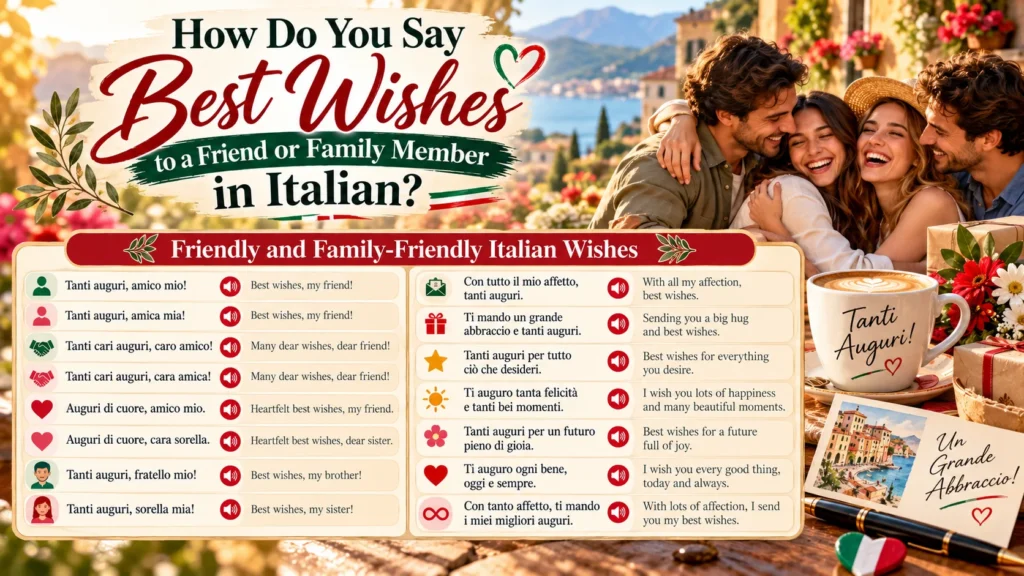
Friendly and Family-Friendly Italian Wishes
- Tanti auguri, amico mio! Best wishes, my friend!
- Tanti auguri, amica mia! Best wishes, my friend!
- Tanti cari auguri, caro amico! Many dear wishes, dear friend!
- Tanti cari auguri, cara amica! Many dear wishes, dear friend!
- Auguri di cuore, amico mio. Heartfelt best wishes, my friend.
- Auguri di cuore, cara sorella. Heartfelt best wishes, dear sister.
- Tanti auguri, fratello mio! Best wishes, my brother!
- Tanti auguri, sorella mia! Best wishes, my sister!
- Con tutto il mio affetto, tanti auguri. With all my affection, best wishes.
- Ti mando un grande abbraccio e tanti auguri. Sending you a big hug and best wishes.
- Tanti auguri per tutto ciò che desideri. Best wishes for everything you desire.
- Ti auguro tanta felicità e tanti bei momenti. I wish you lots of happiness and many beautiful moments.
- Tanti auguri per un futuro pieno di gioia. Best wishes for a future full of joy.
- Ti auguro ogni bene, oggi e sempre. I wish you every good thing, today and always.
- Con tanto affetto, ti mando i miei migliori auguri. With lots of affection, I send you my best wishes.
What Are the Best Wishes for a Formal Italian Message?
For professional or formal communication, I migliori auguri and Con i migliori auguri are safer choices than very casual forms such as auguroni.
The formal wording keeps the message respectful while still expressing warmth and goodwill.
You can also use a complete sentence such as Le porgo i miei migliori auguri when addressing someone formally, although the exact level of formality should match the relationship.
For professional congratulations, congratulazioni can be combined with i migliori auguri when you want to recognize both the achievement and the future ahead.
Polished Phrases for Cards, Emails and Professional Situations
- I migliori auguri. Best wishes.
- Con i migliori auguri. With best wishes.
- I miei migliori auguri. My best wishes.
- Con i miei migliori auguri. With my best wishes.
- I migliori auguri per il futuro. Best wishes for the future.
- Le porgo i miei migliori auguri. I offer you my best wishes.
- Le invio i miei migliori auguri. I send you my best wishes.
- Con i migliori auguri per il nuovo incarico. With best wishes for the new position.
- Congratulazioni e i migliori auguri per il futuro. Congratulations and best wishes for the future.
- I migliori auguri per il meritato successo. Best wishes following your well-deserved success.
- Con sincere congratulazioni e i migliori auguri. With sincere congratulations and best wishes.
- I migliori auguri per questa importante occasione. Best wishes for this important occasion.
- Con stima e i migliori auguri. With esteem and best wishes.
- I migliori auguri per ogni futuro successo. Best wishes for every future success.
- Con i migliori auguri di ogni bene. With best wishes for every good thing.
How Do You Pronounce Auguri and I Migliori Auguri?
Pronunciation matters because a phrase can look familiar on the page while sounding different from English.
Auguri is commonly represented approximately as ow-GOO-ree, with the stress on the middle syllable.
I migliori auguri can be practiced approximately as ee mee-lyoh-ree ow-GOO-ree, although English approximations cannot reproduce every Italian sound perfectly.
For reliable pronunciation practice, language-learning resources such as provide audio practice, while supplies pronunciation guidance for related Italian expressions.
Easy Pronunciation Practice for Common Expressions
- Auguri approximately ow-GOO-ree.
- I migliori auguri approximately ee mee-lyoh-ree ow-GOO-ree.
- Tanti auguri approximately TAHN-tee ow-GOO-ree.
- Tantissimi auguri approximately tahn-TEES-see-mee ow-GOO-ree.
- Tanti cari auguri approximately TAHN-tee KAH-ree ow-GOO-ree.
- I miei migliori auguri approximately ee MYEH-ee mee-lyoh-ree ow-GOO-ree.
- Con i migliori auguri approximately kohn ee mee-lyoh-ree ow-GOO-ree.
- Ti auguro il meglio approximately tee ow-GOO-roh eel MEH-lyoh.
- Ti auguro ogni bene approximately tee ow-GOO-roh OH-nyee BEH-neh.
- Congratulazioni approximately kohn-grah-too-lah-TSEE-oh-nee.
- Congratulazioni e tanti auguri approximately kohn-grah-too-lah-TSEE-oh-nee eh TAHN-tee ow-GOO-ree.
- Con affetto approximately kohn ah-FEHT-toh.
- Buona fortuna approximately BWOH-nah for-TOO-nah.
- In bocca al lupo approximately een BOHK-kah ahl LOO-poh.
- Buon compleanno approximately bwohn kohm-pleh-AHN-noh.
Jump into Other Related Article
- 14th Birthday Wishes for Girl | 200+ Sweet, Heartfelt, Funny & Inspirational Messages
- 16 Wishes Candles | Movie Candles, Sweet 16 Boxes, DIY Ideas & Where to Buy
- Shenron Wishes Xenoverse 2 | All Wishes, Rewards, Dragon Balls & Best Uses
What Is the Difference Between Auguri, Congratulazioni and Buona Fortuna?
These expressions overlap, but they are not interchangeable in every situation.
Auguri is broad and can communicate best wishes, congratulations, or celebration-related goodwill, while congratulazioni focuses more specifically on congratulating someone.
Buona fortuna directly means good luck, so it is better when success in an upcoming situation is the main idea.
Italian also has the idiomatic in bocca al lupo, another established way of wishing someone good luck rather than simply saying best wishes.
Choosing the Right Italian Expression
- Use auguri when you want a broad, natural expression of good wishes.
- Use i migliori auguri when you want an explicit best wishes formulation.
- Use tanti auguri when you want a warm, celebratory version.
- Use tantissimi auguri when you want to make the greeting especially enthusiastic.
- Use congratulazioni when someone has achieved something deserving recognition.
- Use complimenti when you are praising someone’s performance or accomplishment.
- Use buona fortuna when you specifically mean good luck.
- Use in bocca al lupo when you want an idiomatic expression of good luck.
- Use ti auguro il meglio when directly telling someone that you wish them the best.
- Use ti auguro ogni bene for a broad, heartfelt wish for someone’s wellbeing.
- Use con affetto to add affectionate warmth without necessarily sounding romantic.
- Use con amore when the relationship genuinely supports an intimate or romantic tone.
- Use buon compleanno when the occasion is specifically someone’s birthday.
- Use buon Natale when the greeting is specifically for Christmas.
- Use buon anno or tanti auguri di buon anno for New Year wishes.
Common Mistakes When Translating Best Wishes Into Italian
A literal translation is not always the most natural translation because English and Italian distribute meanings differently across greeting expressions.
One common mistake is assuming that best wishes must always become i migliori auguri; while correct, everyday Italian often uses the shorter auguri.
Another mistake is treating congratulazioni, complimenti, and buona fortuna as exact substitutes, even though each has its own typical use.
Understanding the situation first will help you choose an Italian phrase that sounds natural rather than mechanically translated.
Translation Errors to Avoid
- Do not assume auguri only means happy birthday; its use is much broader.
- Do not use buona fortuna when you specifically want congratulations for an achievement.
- Do not use congratulazioni as the only phrase when the main intention is future good wishes.
- Do not assume i migliori auguri is the only correct translation of best wishes.
- Do not translate every best wishes situation literally without considering the occasion.
- Do not use con amore automatically for friends because it can sound more intimate than intended.
- Do not confuse con affetto with a strictly romantic expression.
- Do not treat complimenti as identical to every use of congratulations.
- Do not use in bocca al lupo simply because an English sentence contains best wishes.
- Do not forget that buon compleanno is the standard birthday-specific greeting.
- Do not add unnecessary words when a simple auguri already fits the situation.
- Do not use highly formal language for a casual text unless the context calls for it.
- Do not make a formal card overly casual with expressions such as auguroni.
- Do not assume an English idiom should have a word-for-word Italian equivalent.
- Do not rely only on dictionary meaning; context determines which Italian expression sounds most appropriate.
Ready-to-Use Italian Best Wishes for Different People
The best Italian greeting is usually the one that matches the relationship between the sender and recipient.
A message for a romantic partner can be affectionate, while a greeting for a coworker may need a more neutral and professional tone.
For friends and relatives, tanti auguri and auguri di cuore provide natural ways to make a short message warmer.
The examples below give you complete phrases that can be copied into cards, texts, social posts, emails, or personal notes.
Complete Italian Messages You Can Send
- Tanti auguri! Ti auguro tanta felicità e successo in tutto ciò che fai. Best wishes! I wish you happiness and success in everything you do.
- I miei migliori auguri per un futuro pieno di gioia e soddisfazioni. My best wishes for a future full of joy and fulfillment.
- Tanti cari auguri di cuore per questa bellissima occasione. Many heartfelt best wishes for this beautiful occasion.
- Congratulazioni e tanti auguri per questo nuovo capitolo della tua vita. Congratulations and best wishes for this new chapter of your life.
- Con amore, ti mando i miei migliori auguri per tutto ciò che desideri. With love, I send my best wishes for everything you desire.
- Con affetto, tanti auguri per una vita piena di felicità. With affection, best wishes for a life full of happiness.
- Ti auguro il meglio oggi e per tutti i giorni che verranno. I wish you the best today and for all the days ahead.
- Ti auguro ogni bene e tante belle soddisfazioni per il futuro. I wish you every good thing and many wonderful achievements in the future.
- Congratulazioni per il tuo successo e i miei migliori auguri per il futuro. Congratulations on your success and my best wishes for the future.
- Tantissimi auguri per una giornata speciale, piena di sorrisi e felicità. Very best wishes for a special day filled with smiles and happiness.
- Tanti auguri per il tuo nuovo lavoro; che sia l’inizio di una splendida avventura. Best wishes for your new job; may it be the beginning of a wonderful adventure.
- I migliori auguri per il vostro futuro insieme, pieno di amore e serenità. Best wishes for your future together, filled with love and serenity.
- Tanti auguri di cuore per questo importante traguardo. Heartfelt best wishes for this important achievement.
- Con i miei migliori auguri, spero che ogni tuo desiderio possa diventare realtà. With my best wishes, I hope every desire of yours can become reality.
- Auguri di cuore per tutto ciò che verrà; ti auguro felicità, amore e successo. Heartfelt wishes for everything ahead; I wish you happiness, love, and success.
How to Write Best Wishes in an Italian Card or Message
For a short card, I migliori auguri or Tanti auguri may be enough, but a longer message can add a personal reason for your wishes.
A useful structure is to begin with the occasion, add your good wishes, and finish with a warm closing such as con affetto or con i migliori auguri.
For professional cards, keep the language respectful and focus on success, happiness, or future opportunities.
For family, friends, or partners, you can add emotional words such as cuore, affetto, amore, felicità, or gioia.
Simple Formulas for Creating Your Own Italian Greeting
- Start with Auguri! when you want a short and friendly opening.
- Start with Tanti auguri! when the occasion is celebratory and personal.
- Start with I migliori auguri! when you want a polished written greeting.
- Add di cuore to make the sentiment more heartfelt.
- Add con affetto when writing warmly to a friend or relative.
- Add con amore when the relationship makes an intimate expression appropriate.
- Add per il futuro when wishing someone well in the years ahead.
- Add per questa nuova avventura when someone is beginning an important life change.
- Add per il tuo successo when emphasizing achievement or career progress.
- Add per la vostra vita insieme when addressing a couple.
- Add tanta felicità when happiness is the central wish.
- Add tanta serenità when you want to emphasize peace and wellbeing.
- Add ogni bene when you want a broad, sincere wish.
- Close with con i migliori auguri for a polished card or letter.
- Close with un abbraccio e tanti auguri when the message is personal and affectionate.
Best Italian Phrases to Remember at a Glance
If you only need a few expressions, learning a small group of high-use phrases is more practical than memorizing every possible translation.
Auguri is the essential word because it can cover several kinds of positive wishes in the right context.
I migliori auguri is especially useful when you want an unmistakable equivalent of best wishes, while tanti auguri gives a warmer celebratory feeling.
For special circumstances, remember congratulazioni for congratulations and buona fortuna or in bocca al lupo for good luck.

Your Essential Italian Best-Wishes Vocabulary
- Auguri! Best wishes!
- I migliori auguri! Best wishes!
- Tanti auguri! Many best wishes!
- Tantissimi auguri! Very best wishes!
- Tanti cari auguri! Many dear wishes!
- I miei migliori auguri! My best wishes!
- Con i migliori auguri! With best wishes!
- Ti auguro il meglio. I wish you the best.
- Ti auguro ogni bene. I wish you every good thing.
- Auguri di cuore! Heartfelt best wishes!
- Con affetto! With affection!
- Con amore! With love!
- Congratulazioni! Congratulations!
- Buona fortuna! Good luck!
- In bocca al lupo! Good luck!
Conclusion
So, how do you say best wishes in Italian? The simplest answer is Auguri!, while I migliori auguri! is a more explicit translation of best wishes. Tanti auguri! is another extremely useful expression for warm, celebratory situations. If you want to say I wish you the best, use Ti auguro il meglio, and for congratulations and best wishes, Congratulazioni e tanti auguri! is a natural choice. Italian uses auguri broadly, so the surrounding occasion often determines its exact English meaning.
The key is to choose the phrase according to your relationship and purpose. Use auguri for a simple, flexible greeting; i migliori auguri for a polished best wishes; tanti auguri for warmth; con amore or con affetto when adding affection; and congratulazioni when recognizing an achievement. With these expressions, you can confidently write an Italian birthday wish, wedding greeting, professional message, congratulations note, or heartfelt personal card without relying on a stiff word-for-word translation.
1. How do you say best wishes in Italian?
2. How do you say love and best wishes in Italian?
You can say Con amore e tanti auguri for with love and best wishes. For a less romantic but still affectionate tone, Con affetto e tanti auguri means with affection and best wishes.